Back

Testing

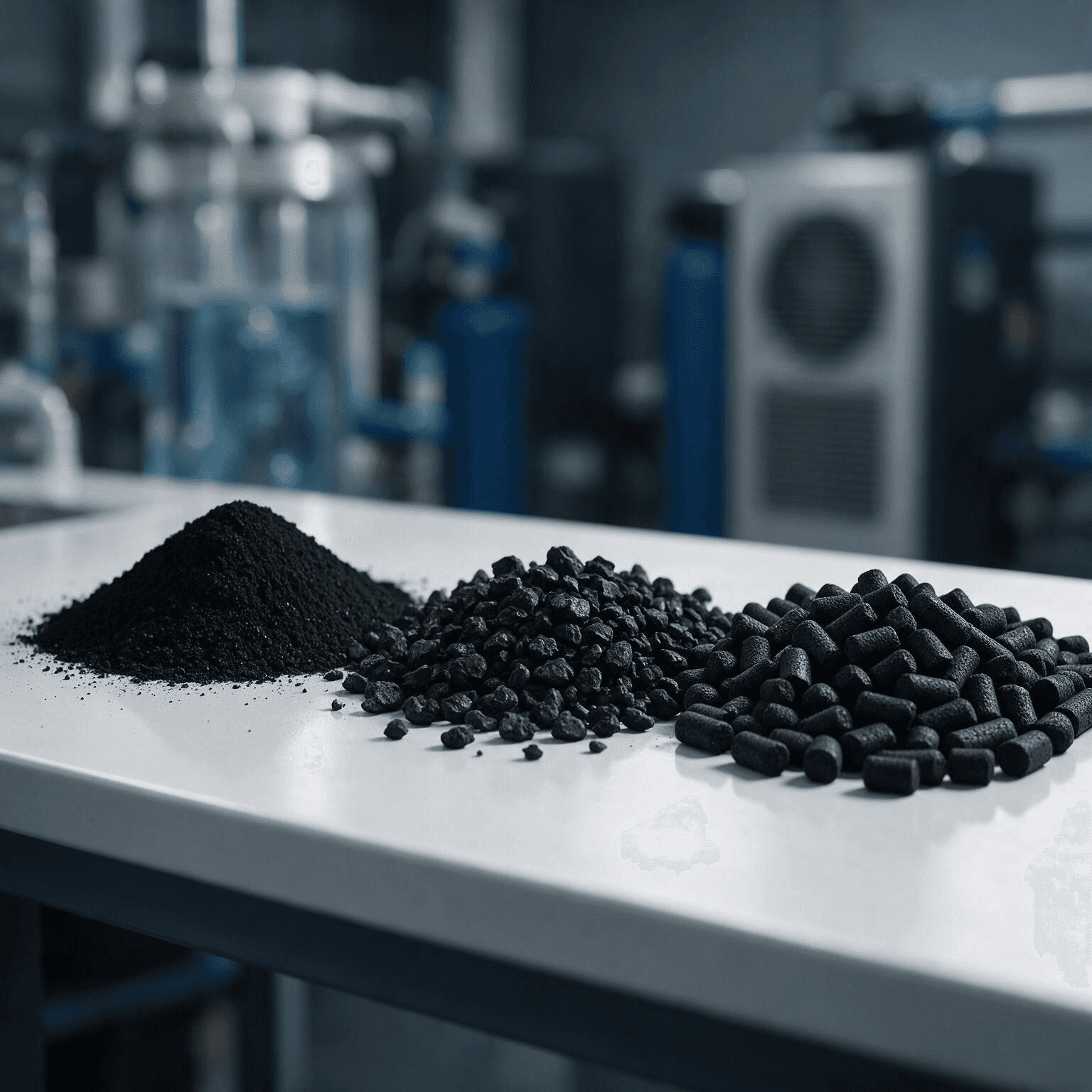
PAC vs GAC vs Pelletised Activated Carbon: Which Form is Right?

PAC vs GAC vs Pelletised Activated Carbon: Which Form is Right?

PAC vs GAC vs Pelletised Activated Carbon: Which Form is Right?

Laboratory beakers on a work surface

Choosing the right form of activated carbon is just as important as selecting the right grade. Powdered Activated Carbon (PAC) is ideal for batch liquid treatment, Granular Activated Carbon (GAC) is suited for continuous liquid purification, while Pelletised Activated Carbon (EAC) performs best in gas and air applications. The right choice depends on your process, operating conditions and regeneration requirements.

Activated carbon is widely used to remove impurities from liquids and gases, but selecting the right carbon isn't only about the raw material. The physical form of activated carbon plays an equally important role in determining how effectively it performs.

Powdered, granular and pelletised activated carbon all rely on the same principle of adsorption. However, they differ significantly in how they handle flow rates, pressure drop, regeneration, carbon loss and operating conditions.

Choosing the right form depends on how your process operates, not simply on the contaminant you're trying to remove. Understanding these differences can help improve performance while reducing operating costs over the long term.

A single palm tree stands against a clear blue sky.
A clear popsicle with strawberry slices on a light background.

Powdered Activated Carbon (PAC)

Powdered Activated Carbon (PAC) consists of very fine particles with a large external surface area, allowing contaminants to be adsorbed quickly. It is commonly used where contamination is temporary, seasonal or varies over time, as it can be added directly into the treatment process whenever required.


Advantages
  • High adsorption rate due to its fine particle size

  • Suitable for batch dosing and intermittent treatment

  • Cost-effective for short-term or seasonal contamination

  • Can be integrated into existing water treatment systems with minimal modifications

  • Effective in removing colour, odour, taste and dissolved organic compounds


Common applications

PAC is widely used in:

  • Municipal drinking water treatment

  • Wastewater treatment

  • Sugar and sweetener purification

  • Edible oil refining

  • Pharmaceutical process liquids

  • Chemical processing

  • Emergency contamination treatment


Limitations

While PAC offers fast adsorption, it is generally not regenerated after use. It also requires downstream filtration to remove the spent carbon, resulting in higher carbon losses compared to fixed-bed systems. Because of its fine particle size, PAC is not suitable for continuous gas-phase applications.


Granular Activated Carbon (GAC)

Granular Activated Carbon (GAC) is designed for continuous treatment processes where the carbon remains inside a fixed-bed adsorption system. Its larger particle size allows liquids to flow efficiently while providing high adsorption capacity over longer operating cycles.

One of its biggest advantages is that it can often be thermally regenerated, making it suitable for applications where long-term operating costs are an important consideration.


Advantages
  • Suitable for continuous fixed-bed adsorption systems

  • Good balance between adsorption capacity and flow performance

  • Can often be thermally regenerated and reused

  • Long operational life with relatively low operating costs

  • Available in different mesh sizes to suit various process requirements


Common Applications

GAC is commonly used in:

  • Drinking water filtration

  • Industrial water treatment

  • Groundwater remediation

  • Gold recovery (CIP, CIL and CIC)

  • Food and beverage purification

  • Aquaculture filtration

  • Low-flow VOC removal

  • Catalyst support


Limitations

Compared to PAC, GAC adsorbs contaminants at a slower rate. It can also experience abrasion if handled improperly, leading to the formation of fines. While it performs well in liquid treatment systems, it is generally less suitable than pelletised carbon for high-velocity gas streams.


Pelletised (Extruded) Activated Carbon (EAC)

Pelletised Activated Carbon, also known as Extruded Activated Carbon (EAC), is primarily used in gas and air purification systems. Its uniform cylindrical shape allows gases to pass through with lower pressure drop while maintaining high mechanical strength.

These characteristics make it particularly suitable for continuous industrial air treatment applications.


Advantages
  • Low pressure drop during operation

  • High mechanical strength with minimal dust formation

  • Well suited for continuous gas-phase purification

  • Uniform pellet size for consistent performance

  • Long service life and regeneration capability in many industrial applications


Common Applications

EAC is widely used for:

  • Air purification

  • VOC removal

  • Solvent recovery

  • Natural gas purification

  • Biogas upgrading

  • Mercury removal

  • Hydrogen sulphide (H₂S) removal

  • Industrial odour control

  • Semiconductor process air

  • Catalyst protection


Limitations

Pelletised carbon is generally not the preferred option for liquid-phase adsorption. It also has a lower external surface area than PAC and typically involves a higher initial investment. To deliver optimum performance, it should be used in properly designed adsorption vessels.


Choosing the Right Form

Rather than asking which activated carbon is ‘best,’ the better question is which form is best suited to your process.

  • PAC is ideal for batch treatment, intermittent dosing and situations where contaminants appear suddenly or seasonally.

  • GAC is the preferred choice for continuous liquid purification and is widely used in water treatment and gold recovery because of its long service life and regeneration potential.

  • EAC is designed for gas and air treatment, where low pressure drop, high durability and consistent airflow are critical.

The right choice depends on factors such as operating conditions, flow characteristics, regeneration requirements and the design of your treatment system.

Powdered Activated Carbon (PAC)

Powdered Activated Carbon (PAC) consists of very fine particles with a large external surface area, allowing contaminants to be adsorbed quickly. It is commonly used where contamination is temporary, seasonal or varies over time, as it can be added directly into the treatment process whenever required.


Advantages
  • High adsorption rate due to its fine particle size

  • Suitable for batch dosing and intermittent treatment

  • Cost-effective for short-term or seasonal contamination

  • Can be integrated into existing water treatment systems with minimal modifications

  • Effective in removing colour, odour, taste and dissolved organic compounds


Common applications

PAC is widely used in:

  • Municipal drinking water treatment

  • Wastewater treatment

  • Sugar and sweetener purification

  • Edible oil refining

  • Pharmaceutical process liquids

  • Chemical processing

  • Emergency contamination treatment


Limitations

While PAC offers fast adsorption, it is generally not regenerated after use. It also requires downstream filtration to remove the spent carbon, resulting in higher carbon losses compared to fixed-bed systems. Because of its fine particle size, PAC is not suitable for continuous gas-phase applications.


Granular Activated Carbon (GAC)

Granular Activated Carbon (GAC) is designed for continuous treatment processes where the carbon remains inside a fixed-bed adsorption system. Its larger particle size allows liquids to flow efficiently while providing high adsorption capacity over longer operating cycles.

One of its biggest advantages is that it can often be thermally regenerated, making it suitable for applications where long-term operating costs are an important consideration.


Advantages
  • Suitable for continuous fixed-bed adsorption systems

  • Good balance between adsorption capacity and flow performance

  • Can often be thermally regenerated and reused

  • Long operational life with relatively low operating costs

  • Available in different mesh sizes to suit various process requirements


Common Applications

GAC is commonly used in:

  • Drinking water filtration

  • Industrial water treatment

  • Groundwater remediation

  • Gold recovery (CIP, CIL and CIC)

  • Food and beverage purification

  • Aquaculture filtration

  • Low-flow VOC removal

  • Catalyst support


Limitations

Compared to PAC, GAC adsorbs contaminants at a slower rate. It can also experience abrasion if handled improperly, leading to the formation of fines. While it performs well in liquid treatment systems, it is generally less suitable than pelletised carbon for high-velocity gas streams.


Pelletised (Extruded) Activated Carbon (EAC)

Pelletised Activated Carbon, also known as Extruded Activated Carbon (EAC), is primarily used in gas and air purification systems. Its uniform cylindrical shape allows gases to pass through with lower pressure drop while maintaining high mechanical strength.

These characteristics make it particularly suitable for continuous industrial air treatment applications.


Advantages
  • Low pressure drop during operation

  • High mechanical strength with minimal dust formation

  • Well suited for continuous gas-phase purification

  • Uniform pellet size for consistent performance

  • Long service life and regeneration capability in many industrial applications


Common Applications

EAC is widely used for:

  • Air purification

  • VOC removal

  • Solvent recovery

  • Natural gas purification

  • Biogas upgrading

  • Mercury removal

  • Hydrogen sulphide (H₂S) removal

  • Industrial odour control

  • Semiconductor process air

  • Catalyst protection


Limitations

Pelletised carbon is generally not the preferred option for liquid-phase adsorption. It also has a lower external surface area than PAC and typically involves a higher initial investment. To deliver optimum performance, it should be used in properly designed adsorption vessels.


Choosing the Right Form

Rather than asking which activated carbon is ‘best,’ the better question is which form is best suited to your process.

  • PAC is ideal for batch treatment, intermittent dosing and situations where contaminants appear suddenly or seasonally.

  • GAC is the preferred choice for continuous liquid purification and is widely used in water treatment and gold recovery because of its long service life and regeneration potential.

  • EAC is designed for gas and air treatment, where low pressure drop, high durability and consistent airflow are critical.

The right choice depends on factors such as operating conditions, flow characteristics, regeneration requirements and the design of your treatment system.
A hand inserting a blue usb drive into a laptop.
Conclusion

Although all three forms of activated carbon work through adsorption, they are designed for different operating environments. Selecting the appropriate form can improve treatment efficiency, optimise operating costs and extend system performance.

Instead of choosing based solely on the contaminant, consider how your process operates, whether it requires batch dosing, continuous liquid treatment or gas purification. Matching the carbon form to the application is key to achieving reliable and efficient results.

Not sure which activated carbon is right for your process? Our technical team can help you identify the most suitable solution based on your application and operating requirements.

Head Office

1604 Lodha Supremus,

Dr. E. Moses Road, Worli,

Mumbai, Maharashtra,

400 018 India

Manufacturing Plant

Plot Nos. R28 - R30,

SIPCOT Industrial Area

Perundurai, Dist. Erode,

Tamil Nadu

638 052 India

Head Office

1604 Lodha Supremus,

Dr. E. Moses Road, Worli,

Mumbai, Maharashtra,

400 018 India

Manufacturing Plant

Plot Nos. R28 - R30,

SIPCOT Industrial Area

Perundurai, Dist. Erode,

Tamil Nadu

638 052 India

Head Office

1604 Lodha Supremus,

Dr. E. Moses Road, Worli,

Mumbai, Maharashtra,

400 018 India

Manufacturing Plant

Plot Nos. R28 - R30,

SIPCOT Industrial Area

Perundurai, Dist. Erode,

Tamil Nadu

638 052 India

INDUSTRIES

CAPABILITIES

COMPANY
